
The Land Does Not Wait for the Ballot Box
By Elisha Yered, Settlement Activist
This Olam Katan article is a translation of https://www.okn.co.il/opinions/73939/
The achievements of the outgoing government are impressive, and on the hilltops the next goals are already being marked: canceling the Oslo Accords, changing the land laws in Judea and Samaria, and improving the treatment of hilltop youth. Even if a problematic government is formed, it is important to outline these plans now.
“Shepherd. Photo: Haim Goldberg, Flash 90”
Like most of the columns that will appear this week in the Shabbat pamphlets, this one was written on Tuesday, before the election results were known. I sincerely hope that by the time you read these lines you have already heard of the victory of the right-wing camp. But even if, heaven forbid, God has decided for a time to place the wheel in the hands of other, dangerous parties, this column remains relevant, because it does not deal with political commentary.
Whoever wins the elections must continue the upward progression
Whether a right-wing government is formed this time or its establishment is delayed by a few months or years, we are obligated to map out right now the next targets that the elected representatives of the national camp must carry out. In the past four years we have covered real ground, and it seems the pace of redemption has shifted into a higher gear after decades of lagging behind. Precisely for that reason we must not rest on our laurels or slow the pace for even a moment. No one knows how much longer we will be allowed to hold the wheel, and in order to correct failures of more than a generation we need every moment.
Summarizing the achievements of the outgoing government would require several full issues, and those will come in due time, G-d willing. In this column I wish to focus specifically on the tasks and next steps that lie before us and are necessary to advance the struggle in Judea and Samaria.
What Was
If there is one thing the outgoing government can clearly claim credit for, it is the bold renewal of official settlement. For roughly a quarter of a century the State of Israel absurdly refrained from establishing new communities in Judea and Samaria. There was no shortage of state land on which completely legal settlements could have been built, and there were even right-wing defense ministers who could have provided the required signature. Yet in practice it did not happen—sometimes because of American pressure, sometimes out of fear of left-wing organizations, and all too often simply because of a grasshopper mentality that trembled at every rustling leaf.

Yonatan Zindel, Flash 90
Let us be precise: even within the existing legal framework of the State of Israel—built as it is on bizarre Ottoman laws and dictatorial legal restrictions—the state still refrained from acting. The public impression took hold that it was impossible to establish communities in Judea and Samaria today without far-reaching legislative reforms.
In the current government we suddenly discovered that there had never been any real legal barrier, and that if the state wants to, establishing a community is not particularly complicated. With Minister Smotrich in charge of the Civil Administration and Minister Katz at the Defense Ministry, all that was needed was staff work, a few approvals and signatures, and the bulldozers could already set out. Thus dozens of communities went up on the ground one after another in recent months, sometimes at a rate of one or two a week. In only about two years the government closed a decades-long gap and approached the point of utilizing state land in large parts of Area C. Now that this stage has largely been decided, and what remains will, G-d willing, proceed calmly along the main path, we must look at the urgent challenges ahead.
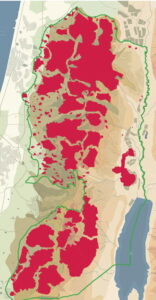
“Areas A and B are 6 times the size of the Gaza Strip. Photo: none”
First and Foremost: Canceling the Oslo Accords
Until two years ago, Olam Katan was almost the only media outlet that dared to raise this demand in a clear voice. To most people, including many within the settlement enterprise, the goal seemed unnecessary and, above all, unrealistic. In a short time a reversal occurred in public opinion, and today there is not a single right-wing party that does not publicly support it: from Ben-Gvir to Netanyahu, all warn against the Palestinian Authority’s army and its control of the territory, and fully share the understanding that a Palestinian terrorist state in large parts of Judea and Samaria would be a disaster. Yet as in many other issues, words must be turned into deeds. Talk of toppling Abu Mazen’s regime is nice, but without returning these areas to full Jewish control that includes civilian settlement, it will be meaningless.
In the past three years, activists on the hilltops—including members of the Gvaot HaHazit administration, of which I have been privileged to be a member—have led strategic plans for establishing communities and seizing control points in Areas A and B. So far about thirty settlement points have been established in these areas, currently home to only dozens of families and hundreds of young men. Most already have minimal infrastructure thanks to intensive activity and broad public support, and roughly 70 percent of them enjoy relative quiet without harassment or evacuations.
Remove demolition, regularize existing points
The first step of the next government on the road to canceling the Oslo Accords need not be drastic or complicated. It can begin with regularizing the existing points, or even with removing the sword of demolition from over them by designating them for regularization. The history of Judea and Samaria from the days of Gush Emunim until today teaches that although we all want the state itself to lead the breakthroughs in settlement, in reality it is the citizens who time and again are forced to do so and pull the state forward. We should strive to correct this situation, but at the same time recognize that until that happens we must not sit with folded arms and wait for initiative from the government.
As imperfect as the reality is, it also has advantages. The Israeli government is frequently influenced by changing external pressures and cannot always act as it wishes. In contrast, proxy forces from within the public can carry out a mission that enjoys wall-to-wall support without becoming entangled in such complications. When the pressure eases, the state can always join officially. This is how settlement has operated since its earliest days, but the time has come to improve this working method so that it becomes several times more effective.
For many years the pioneering trailblazers received recognition and assistance only after they had already won the battle, and were forced to fight alone without any governmental support. Unfortunately, one cannot say that anything changed under the outgoing government. Government support—even the under-the-table kind—was transferred only to those who had already been regularized in one form or another. The activists who were simultaneously struggling for the next stage, settlement in the Oslo areas, did not even receive basic security components. There are excuses and explanations for this lack of backing as plentiful as water, but we all know that when government elements want to support something, ways will be found, however circuitous.

Oslo Accords. Photo: free
Removing the Ottoman Handcuff
We frequently point to the Oslo Accords as the factor preventing settlement in tens of percent of Judea and Samaria, yet there is another absurd limitation no less severe. The areas of Judea and Samaria are divided according to two parallel parameters. One is the status of the authority that controls them, determined when they were divided in Yitzhak Rabin’s time into A, B, and C. The second, which preceded it, is the supposed ownership status of the land. The latter ranges across a series of legal definitions, from private Palestinian land registered in the tabu, through unregistered private land and survey lands, to declared state lands. We will not enter the thicket of the legal details now; we will only emphasize again that these are parallel categories. There are many Area C lands defined as private Palestinian land and ostensibly blocked to Jewish settlement, and conversely there are state lands that over the years were defined as Area A.
In other words, even after we cancel the Oslo Accords, G-d willing, many areas throughout Judea and Samaria will still remain in the status of private land, and of course today there are many lands in Area C in a similar legal situation. In the center of Binyamin, for example, the proportion of land defined as private Palestinian land registered in the tabu is enormous. The reason is the incomprehensible adoption by the State of Israel of the fictitious land registration carried out by King Hussein of Jordan before the Six-Day War.
With the aim of consolidating Arab ownership in the region, King Hussein of Jordan began in 1964 a massive operation to register all the lands of Judea and Samaria in the names of private Arab farmers. He concentrated efforts first in the Ramallah district and later moved to other districts. Three years later, while the land registration was still underway, we succeeded in liberating this region of the land and removing him from here.
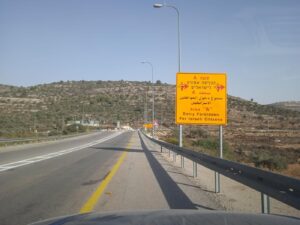
“Sign forbidding entry of Israelis. Photo: The Jewish Voice”
The State of Israel did WHAT…?
Yet in a bizarre step that will be wept over for generations, the State of Israel decided to officially accept Hussein’s fictitious land registration, which was itself based in part on an even more fictitious registration by the Ottoman administration. And as if that were not enough, the state adopted the Ottoman law that recognizes the ownership of a squatter over land by virtue of a few years of possession.
As a result, there are today more than two million dunams in Judea and Samaria with this status, even though in many cases even their Arab “owners” are unaware of the existence of land supposedly registered in their name. Some have lived in Jordan for decades, some emigrated to other countries, and some have not even bothered to pay the Authority the annual fee because of a lack of connection to the land. Applying sovereignty means first and foremost erasing the antisemitic laws of the enemy and enacting new Israeli laws. Before everything and after everything, we of course recall that only the full expulsion of the enemy from here will truly bring peace and security.
The Attitude Toward the Hilltop People: A Good Beginning, But There Is Still a Way to Go
Finally, one cannot avoid mentioning the steps of persecution against the settler public, which continued with even greater intensity during the current government, which failed—and some would say did not try hard enough—to eradicate them from the land. At the top of the list stands the Jewish Division of the Shin Bet, a hostile body whose very existence testifies to the security establishment’s attitude toward right-wing people as toward an enemy.
Even hours after the start of the massacre in the Gaza Envelope, the people of that rotten organization focused on “Jews who are arming themselves” in Judea and Samaria. Throughout the war they confiscated weapons intended for self-defense, dragged fighters and security personnel into interrogation basements infested with mice, and were even recorded admitting their intense hatred of the settlers. Closing the division is obligatory and self-evident. Those who commit criminal offenses can always be dealt with by the Israel Police, as with any citizen in the country.
Overhaul the system
After it come the IDF, the Israel Police, and the Civil Administration, which have undergone a certain change but urgently need a systemic overhaul. The number of demolition incidents that occurred in the settlement enterprise over the past year alongside the approval of communities is very worrying and shows that there is definitely more to correct. Administrative orders are also becoming harsher by the day. Although administrative detention orders were canceled by a brave decision of Minister Katz, the other administrative restriction orders—which include full house arrest and reporting every few hours to a police station—were put into wholesale use in their place. Most severe of all are two destructive and unprecedented tools introduced against the pioneers of settlement during the days of the right-wing government: the confiscation of flocks of sheep on the hilltops and farms in an attempt to prevent the holding of the land against Authority takeover, and the imposition of enormous fines and lawsuits for the costs of evacuation against families whose homes were destroyed. If these tools are not taken out of use soon, they will yet bite hard even the moderate and establishment-oriented among the settlement people.
Much work awaits the next right-wing ministers, but in any political constellation we citizens must not sit with folded arms. In the end it is the ground that wins and leads; the elected officials take the complementary step. We continue forward with full force toward the complete Land of Israel!