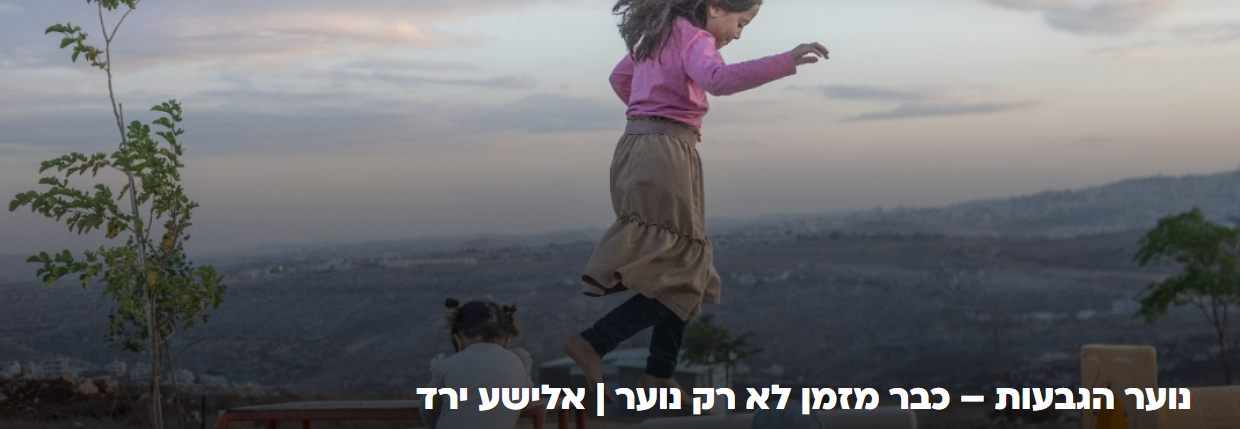

While the media competes to estimate how many young people live on the hills, hundreds of pioneering families have quietly taken the wheel in recent years. What is the current number of populated hills in existence today, and how did a handful of teenagers keeping a flame alive transform into a public sector leading the struggle for Judea and Samaria?
Every few months a stormy debate erupts in the media over the number of people belonging to the group known as the “Hilltop Youth.” “We are talking about seventy youth from broken homes,” the prime minister recently stated in an interview on American television. “Security officials” warned that the number has jumped to 300, while others argued the opposite—that it is roughly 150 people staying on the hills and outposts.
A government plan launched by Avichai Tnaami, the coordinator for Hilltop Youth affairs in the Ministry of Defense, claimed to have determined the exact number after a mapping process: 657 across the farms and hills combined. Yes, no more and no less. So, what is the answer to this million-dollar question? I will give you a disappointing spoiler: Even in this column, despite being a resident of the hills, I cannot state the exact number.
Still, you should not miss this column. The number of pioneering youth on the hills today is highly respectable, and many more join every month. The staggering statistic, however, is the growth rate over the past decade. It is not merely the growth in the number of young people, but the transformation of a small, alienated group into a fully fledged public sector that is making history in Judea and Samaria and winning broad support from wall to wall.
“They Are Not Loners”
Back in the Hebrew year 5775 (2015), during my early days on the hills, a few friends and I sat in a small wooden shack that could barely withstand the fierce winds battering the mountaintop. Smartphones were not really part of our lives then. We even frowned upon mentioning them. Our only connection to the outside world—meaning what people were saying about us in the media—came through video clips of news reports downloaded onto our basic Nokia devices.
One of the reports broadcast on Channel 2 transitioned into a heated panel discussion. “But Amnon, why aren’t they catching them? After all, we’re dealing with just a few lone youth,” host Oded Ben-Ami asked political and legal commentator Amnon Abramovich. Abramovich quickly and decisively pushed back: “They’re not loners. They’re a few thousand loners. And that’s why they’re not catching them.” To this day I will never forget the roars of laughter that echoed across the hill, because at that exact time only two populated hills in all of Judea and Samaria existed.
Those hills were occupied by twenty youth at most, none older than seventeen. It was a difficult transitional period. The previous generation, which had begun with the “Youth for the Land of Israel” organization, had mostly settled into bourgeois life. The few who remained were largely wiped out by a wave of administrative restraining orders and severe harassment. Any young person who stayed on a hill for more than four consecutive months received an administrative order, renewed from time to time, resulting in a ban from Judea and Samaria for at least the next two years.
Only Two Hills, Back Then
I fully joined the activities during this period. We remained on the ground—a handful of teenagers lacking basic experience but filled with stubbornness and simple faith that compensated for everything. There were only two hills, total: Geulat Zion in the Shilo bloc and Givat HaBaladim near Kochav HaShachar. Once a week a campaign of destruction would take place on these two hills to ensure that neither managed to establish itself.
In addition to the demolitions, special task forces from the Central District Police (Yamar) and the Special Patrol Unit (Yasam) would raid the hills at least once a day and arrest anyone they managed to catch. There is no doubt we came out of those days in good physical shape. Only one family—the Shapira family—managed to survive on the hills throughout this entire period despite the harsh routine of evictions on Givat HaBaladim, where they lived.
They lived in wooden shacks that were destroyed and rebuilt, then moved into cheaper tents. When those too were repeatedly destroyed, the family tried to replace their residential tent with a towed caravan in the hope that the bulldozers would bypass it. Instead of demolishing it, Civil Administration inspectors loaded it onto a tow truck and carted it off to the impound lot. Bringing additional families was something one could not even dream about.
The Campaign for Open Spaces Will Decide the Fate of Judea and Samaria
For nearly three years we held on by our teeth entirely on our own—a group of young men without families, driven by one clear goal: keeping the flame of settlement alive outside the fences of the established communities. We knew with all our hearts that the campaign for the open spaces would decide the fate of Judea and Samaria. We received banishment orders, passed the reins to others, and returned to the field the very day the order expired.
About eight years ago the severe wave of persecution that had battered the hills began to fade. Police raids stopped, the security establishment ceased treating mere presence on a hill as a grave criminal offense, and the campaigns of destruction moderated somewhat. Simultaneously, the Israeli public began to be exposed to the plans of the Palestinian Authority and to understand the vital importance of settling the open areas. The debate shifted from asking why this needed to be done at all to seeking advice on how to do it right.
The widening support brought two developments: an increase in the number of activists and families seeking to join, and a reduction in the scope of institutional harassment. For the first time, reasonable conditions for families were created. You still needed to be “crazy” to move with your family to one of the hills, but only a year earlier, even if you were, the atmosphere of persecution had simply made it impossible.
Givat Kumi Ori in Yitzhar Signaled the Change on the Ground
The first sign of the changing reality came from Givat Kumi Ori in Yitzhar. After several years of single young men living on the hill, one of them got married and established his home there. It was a day of celebration for all the hills, whose number had already grown to five. A few months later another young man from the hill married, and subsequently two more couples moved there. The reality of four families living on a single hill still seemed entirely imaginary.
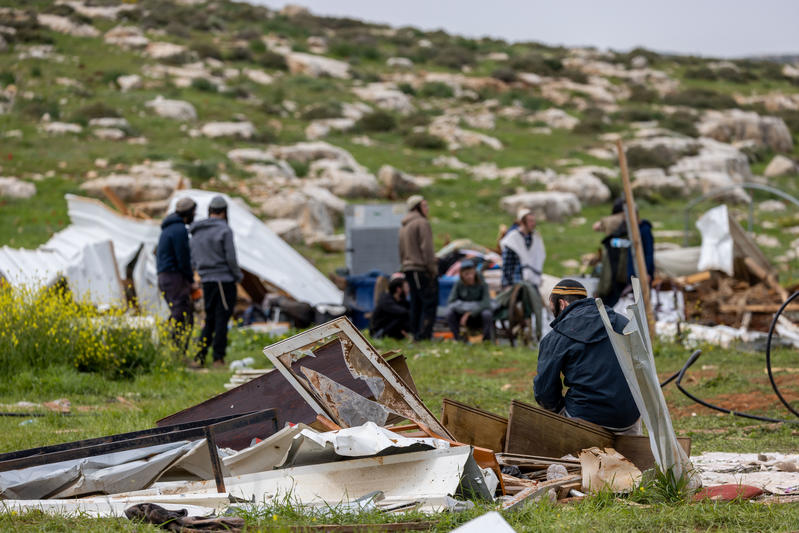
It is strange to think about it now, but when my wife and I got married and became the first family in Maoz Esther, we were actually only the seventh family across all the hills combined. This happened just seven and a half years ago, yet it feels as though a generation has passed. In those days the first great breakthrough began. After a year in Maoz Esther and three evictions, another family joined the hill.
At the same time two other families moved to Givat HaBaladim, which had meanwhile received its official name, Ayira Shachar. Joining the list of hills that changed status within a short time—from a youth outpost to a hill of families—were also Kol Dodi near Kochav HaShachar, Geulat Zion in the Shilo bloc, and Oz Zion near Givat Asaf.
The Directors of the Hills
During the twilight of the Bennett-Lapid government, a harsh wave of destruction was unleashed across all the hills. Week after week, bulldozers accompanied by hundreds of police officers moved from hill to hill and erased any new construction. To break the spirit was the goal. The families held on by their teeth and demanded that the right-wing Members of Knesset put an end to this injustice the moment they returned to power. Indeed, this powerful wave halted on the night the current government was established.
 Minister Smotrich. Photography: Yonatan Sindel, Flash 90.
A few secondary waves still followed, including the destruction of three family homes in Givat Ayira Shachar under the authority of Minister Smotrich, but the intense frequency that had made it impossible to keep one’s head above water ceased. Later, evictions on these veteran hills stopped completely. A few months before the war, a new era began on the hills. The six or seven veteran hills’ absorption of families accelerated; following this, a new wave of settlement outposts establishing themselves on the land resulted.
The breathing room granted to the veteran hills led, for the first time, to the joining of families with many children and even relatively middle-class families who could not have withstood a routine of evictions and destruction. The front line skipped forward to the newly established hills. The removal of the constant threat of destruction from the older hills meant that within a single political term they all turned into young communities in every sense. Each now has twenty to thirty families, and the momentum continues to grow. This achievement, by no means minor, lends credit in significant measure to Minister Smotrich.
Support for the Hills and Farms Reached New Heights
The October 7 war that erupted without warning shook the entire nation of Israel and changed the security perception of its citizens. Within a few months almost every right-wing person—especially those living in the settlements—understood that control over the open spaces is vital. Without it, even their own fenced communities would not be secure. Support for the hills and agricultural farms reached new heights, and the number of people who physically joined the effort soared.
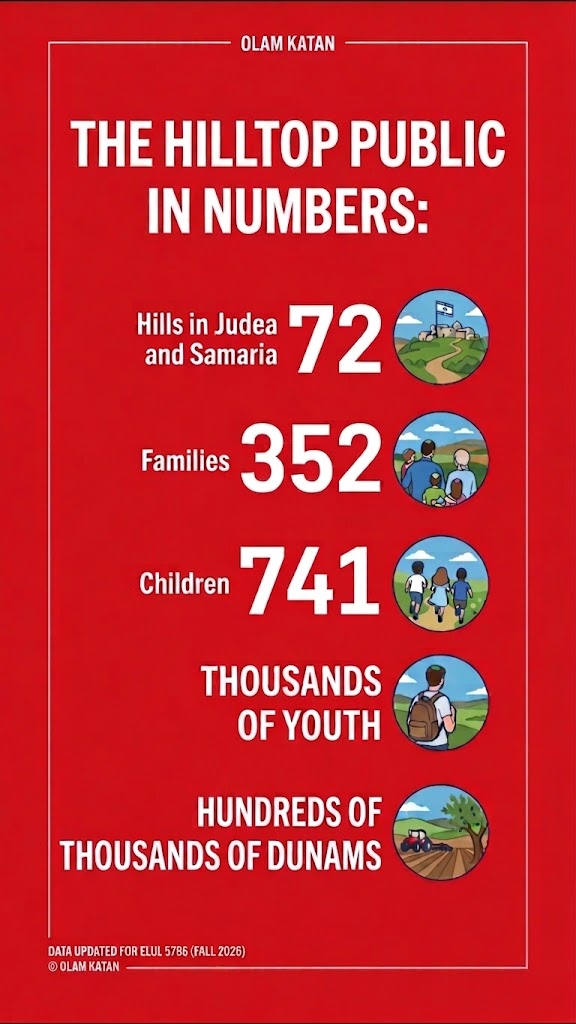
Within just one year another wave of new settlement points was launched, many of them already within Area B. Automatically the line of friction skipped forward as well, and the second generation of hills became rear positions free of evictions, allowing them to begin establishing themselves. If we briefly review the state of the hills today, the figures are highly impressive. No fewer than seventy hills spread across Judea and Samaria, with the Binyamin and Samaria sectors topping the list.
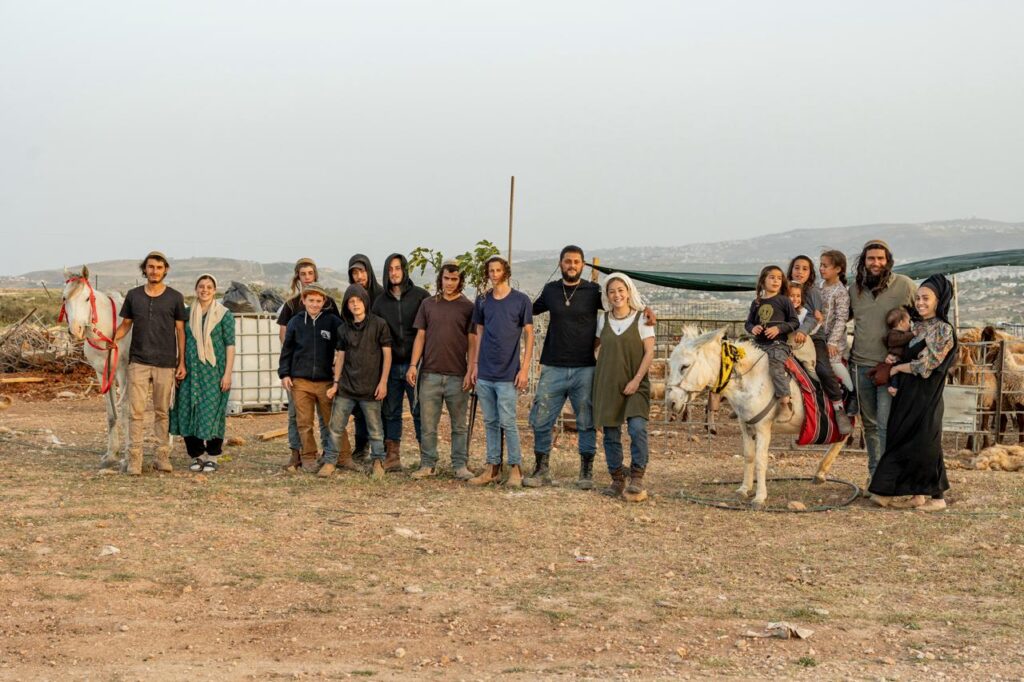 Tel Talpiot Hill. Photography: Naama Stern.
About ten hills are already young communities, and accelerated absorption will likely double the number of families living in them within a year or two. Behind them are another fifteen hills in intermediate stages, each housing between three and ten families, and roughly forty-five newer hills established over the past two years, which accommodate an average of one to four families each.
Families Present in More Than Ninety Percent of the Hills
In fact, more than 90 percent of the hills today have families, and those families manage the sites themselves. The father of the first family, who usually serves as the director of the hill, is aided by the single young men who form the settlement nucleus in the area. He guides them, gives them a warm home and a listening ear, and provides everything the youth require.
We tend to speak repeatedly about the youth on the hills, while barely mentioning the families who navigate the ship and lead the operations. In the Frontline Hills Directorate—the organization I am privileged to belong to, which established twelve new hills in the past year alone—we emphasize exactly this point. Every hill has a director who holds authority over the place and navigates operations at every crossroads. The youth are proud to follow him and learn from his experience.
And since we are already talking about youth, let us present a few data points. Every hill has an average core group of five to eight young men defined as permanent residents. They bear responsibility for running the farm and developing the territory, pull guard shifts and herding duties, and define the place as their actual home. In addition, every hill has a secondary circle of several dozen volunteers who are an inseparable part of the nucleus; without them the permanent residents could not withstand the workload.
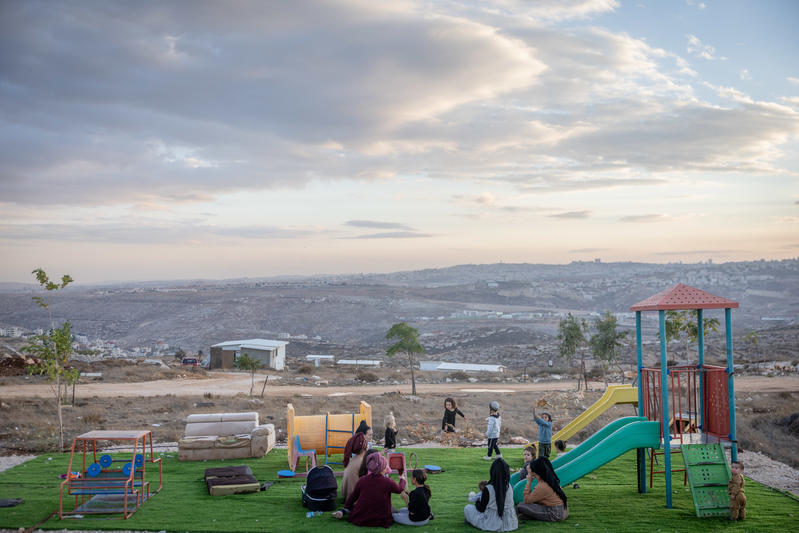 Ramat Migron. Photography: Haim Goldberg, Flash 90.
Driven by a Sense of Mission and a Desire to Take Action
The volunteers are yeshiva students or young men who have entered the workforce. They arrive at varying frequencies—ranging from staying overnight on a regular basis to pulling night shifts once a week. They define themselves as full-fledged Hilltop Youth (“Giva’onim”) in every sense, but for the time being they choose not to bear the full commitment of the grueling daily routine on the hill. I meet these young men during their very first days on the hill, when they are enthusiastic yet still bashful.
A sense of mission and a desire to take action drives them. They arrive with the mindset that they will conquer the world. Most of them did not leave the yeshiva because of difficulties with studying, but rather out of a desire to give more to the People of Israel than they felt they were contributing there. Some are also looking for a bit of action, but for most this quickly balances out—and those who do not adapt simply leave. People often label the youth on the hills as “youth at risk” who come to cast off burdens and accountability, but the truth is that the demanding routine governing the hills simply does not allow such youth to survive here for long.
These are not the lazy kids many people think of. Take note.
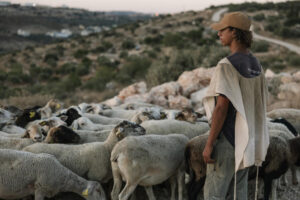
No teenager searching for direction in life yet looking to escape accountability would willingly throw himself into a life of guarding for three hours a night, herding sheep for eight hours in the blazing sun, working until dark, and scrambling for unexpected incidents around the clock in any weather. This column is far from a final summary. In two months, God willing, the data here will likely no longer even be relevant.
Nevertheless, this is undoubtedly a gratifying moment to stop and observe this wondrous community that is taking shape right before our eyes. Pioneering families, dedicated and high-quality youth, and soon the second generation will join them. The results: Hundreds of thousands of dunams, including areas within the Oslo Accords territories, are returning to Hebrew hands after two thousand years of exile through a determined struggle filled with faith and love for the Land. How fortunate we are to have merited this.