Aggressive Officers, Broad Powers, and Dedicated Forces: The New Evacuation Headquarters Exposed
translation of Elisha Yered’s article in Olam Katan. https://www.okn.co.il/opinions/84167/
The new government has not yet been sworn in, but the security establishment is already preparing for the “day after” and shifting sharply leftward. Forces have been diverted from the Jordanian border, authorities have been stripped from brigade commanders, and a veteran Border Police officer has been recalled to reserve duty. Behind the scenes of the new evacuation headquarters in Judea and Samaria stands a supreme mission: pushing the settlement enterprise back to the borders of the Oslo Accords.

[Image: Yaron Plumbo and Avi Cohen. Photo: From the X account of Eyena Ben-Adrat and the Facebook page of the Beit Aryeh Council]
A Border Police company racing up the hill looked more determined than ever. Officers advanced in two columns, quickly surrounded the houses, and urged the bulldozer operator to begin. The orders were precise and sharp. Any resident who dared approach received pepper spray in the face; if that was not enough, stun grenades followed. Less than half an hour later the force left, leaving behind a cloud of dust, a pile of ruins, and many broken hearts.
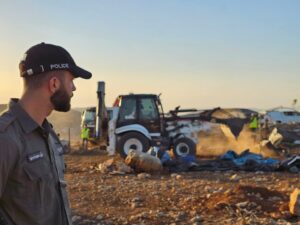
[Image: Destruction on the hills. Photo: Uncredited]
The residents refused to give up. They cleared the rubble, brought in new building materials, and within a few hours the structures were standing again. Hope returned to the outpost—hope that after the destruction it would be given a little breathing room. But hope is one thing and reality another. The next day at the same hour, another Magav (Israel Border Police) company swept through like a storm—skilled, violent, and purposeful. The buildings were destroyed and the residents pushed aside brutally. Once again the young men set about rebuilding.
When the same scene repeated itself for the sixth and seventh times, and dozens of Magav officers continued to raid every day like clockwork—without regard for security incidents in the area or serious terrorist attacks that had occurred there—the people on the hill realized they were facing a different kind of force. A closer look revealed the truth: a special headquarters had been set up in the sector for a temporary period, supposedly to deal with “Jewish terrorism.” In the absence of real activity of that kind, it was cynically redirected to the repeated demolition of Jewish settlement points.
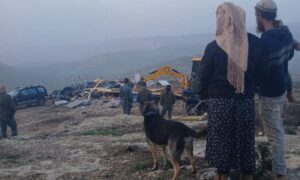
The officers sit at the base, prepare for the next eviction, and heavy engineering equipment is always ready beside them. They raid the hill, return to base to rotate forces for the next demolition, and the cycle continues. An entire company of fighters is effectively revolving around a single settlement point—Kochav Yehuda in Gush Etzion, located between Efrat and Tekoa.
The headquarters’ activity has produced unprecedented numbers: no fewer than 66 evacuations and demolitions took place in Kochav Yehuda in just two and a half months. No one in the security establishment rose to protest the madness openly, not even at the blatant diversion of forces from the mission they were supposedly assigned—enforcing the law against nationalist crime. On the contrary, some described it as a tremendous achievement and carefully stored the model for the next opportunity.
A New and Murky Wind
Since the election results were published about a month ago, the wind blowing from the upper echelons of the security establishment has changed sharply. Whether out of a desire to throw off restraint and return to the old security conceptions, or out of career ambition, the leadership of the police and the IDF is doing everything possible to signal a leftward shift.
It is not that some of them previously refrained from placing obstacles in the way of the elected government’s policy. Now, however, there is no longer anyone to fear, and everything can be done openly. The first to step forward publicly were Chief of Staff Eyal Zamir, who had opposed the attack on Iran, and Police Commissioner Danny Levy, who has taken every possible step in recent weeks to undermine National Security Minister Itamar Ben-Gvir. After them came Central Command commander Avi Bluth, Judea and Samaria Division commander Kobi Heller, and even Shai District commander Moshe Pinchi, who until recently was considered close to Ben-Gvir.
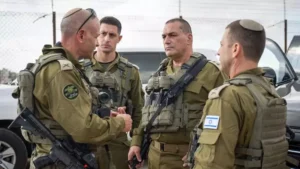
[Image: Judea and Samaria Division commander Kobi Heller with the Chief of Staff and the Central Command general. Photo: IDF Spokesperson]
The restraints have been released. Militant statements against pioneering settlement have grown sharper. Time and again the three officers declared: “This time we will put an end to it.” The statements were directed at the pioneering settlement enterprise—or, as the media prefers to call it, the “outposts.” These are the roughly thirty hills currently located in Areas A and B (the zones under full or partial Palestinian Authority control under the Oslo Accords) that effectively nullify the Oslo agreements on the ground. Gadi Eisenkot still stammered when asked about the agricultural farms in Area C (the area under full Israeli civil and security control), but regarding every other place that might obstruct the establishment of a Palestinian state, his position remained firm: they must be evacuated immediately.
The message filtered down quickly. The command hurried to prepare for pushing the settlement enterprise back to the Oslo borders after years of significant growth. A new special headquarters was established to centralize this effort and was immediately given broad authorities and high priority. Drawing lessons from past cases in which security considerations had overridden operations against settlers, the security establishment this time allocated dedicated forces that would focus exclusively on the Jewish side. Two experienced officers from the police and Magav were chosen to lead the headquarters, and the decision-making process was restructured to make frequent evacuations easier.
Until now the security establishment has preferred to keep these changes far from the public eye. Yet Israeli citizens have the right to know how the decision-making chain works and who is responsible for the brutal demolition campaigns now underway. What follows is a brief look at the mechanism behind the intensive evacuations—which will almost certainly intensify in the coming period.
The Return of Plumbo
The objective is clear: erase the settlement points that endanger the future of a Palestinian state. Because this goal would not go down smoothly with the Israeli public, a simple method is used: the campaign against “settler violence.” After another media storm, special forces are demanded to fight “Jewish terrorism.” The political echelon yields and approves the request. The forces—already largely idle because the phenomenon itself is minimal—are then directed approximately 95 percent of the time against the settlement enterprise itself.
The temporary headquarters established about half a year ago in Gush Etzion is a clear example. Apart from grinding the buildings at Kochav Yehuda—a pioneering hill—it has done almost nothing else. In its public statements the headquarters is presented as a body fighting “nationalist crime.” In practice, the bulk of its activity consists of repeated demolition campaigns that are rarely reported. The method is transparent: receive public credit for fighting crime, then use the forces for political persecution. Beyond the direct harm to the settlements, this is a betrayal of public trust. It is comparable to a regional commander in the Bedouin areas who receives a hundred fighters to combat weapons smuggling, then sends them instead to issue traffic tickets in nearby towns.
The security establishment assigned this role to Samaria District Commander Chief Superintendent Avi Cohen. Only about a year and a half earlier, Minister Itamar Ben-Gvir had appointed him and taken pride in the appointment. No one imagined that Cohen would so quickly reverse course against the minister who appointed him. In the past, the Central Command and division commanders would convey general policy, while the regional brigade commanders carried out demolitions according to their professional and security judgment. Now all the authorities have been concentrated in Cohen’s hands. He sets the weekly evacuation schedule, decides how many times and with what force a hill will be cleared, and orders the forces into action.

[Image: Chief Superintendent Avi Cohen. Photo: From the Facebook page of the Beit Aryeh Council]
Since his appointment, several violent evacuations have already taken place. In one incident on a Samaria hill, a tractor destroyed a house in a life-endangering manner while more than ten youths sat on its roof. Under Cohen’s command operate several dedicated Magav companies, most of them composed of reservists. It is doubtful whether those reservists knew what missions awaited them when they left their families to serve.

Unlike the brigade commanders, who until now generally weighed the overall security situation and sometimes postponed evacuations when necessary, the new headquarters operates differently. Even in the event of a serious terrorist attack or major brigade-level operations that would require additional forces, the headquarters’ units continue their activity as usual.
How high a priority has the headquarters been given? According to a report this week by Eyena Ben-Adrat on Galei Tzahal (Army Radio), Magav forces under the headquarters were diverted from the Jordanian border despite the growing threat of infiltration tunnels and weapons smuggling. The decision has already drawn sharp criticism from the regional councils, but Central Command has refused to reverse it.
This week the headquarters received another significant reinforcement. Chief Superintendent Yaron Plumbo, a senior officer with more than fifteen years of experience in Magav Judea and Samaria, was appointed to co-lead the headquarters alongside Cohen. Until now Cohen directed operations from above; Plumbo, who is highly experienced in demolition operations, will apparently coordinate activity on the ground.
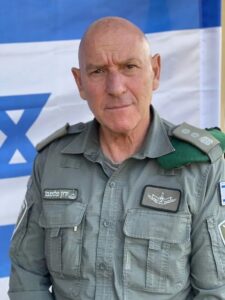
[Image: Yaron Plumbo. Photo: From the X account of Eyena Ben-Adrat]
Almost every activist involved in the settlement enterprise a decade ago remembers Plumbo well. Now approaching 67 and long past the normal retirement age, he chose to return to reserve service. Those who know him describe the same figure: aggressive, closed, and uninterested in dialogue. He comes to cut down and leave scorched earth. Plumbo does not possess particular expertise in investigating nationalist crime—the mission the headquarters claims as its purpose. Experience in carrying out evacuations and demolitions, however, he has in abundance.
A friend from that earlier period remarked this week with irony: “We will yet miss the gentler officers we had until now—a few stun grenades and some pepper spray here and there. Plumbo is in a different category.” Fighters who served under him in the past note that his office is decorated with a certificate of appreciation for demolitions he conducted in the Binyamin region about twelve years ago. The certificate shows a frightened mother and child after officers had expelled them from their home.
In the years since, Plumbo changed positions, moved between sectors, prepared for retirement, and eventually returned. The hill he once destroyed in Binyamin has become a young and thriving permanent community, and dozens more have been established in its wake despite the obstacles. Who knows—perhaps this time Plumbo will have the wisdom to listen to reality and choose to stand on the right side of the history of the Jewish people in its land.
Key terms for English readers
- Magav / Border Police: Israel’s Border Police (Mishmar HaGvul), a multi-purpose force under the Israel Police that often handles security and law-enforcement missions in Judea and Samaria.
- Oslo Accords: The 1990s agreements between Israel and the PLO that created the Palestinian Authority and divided the territory into Areas A, B, and C.
- Areas A and B: Under the Oslo Accords, these zones are under full or partial Palestinian Authority control.
- Area C: Under the Oslo Accords, this zone remains under full Israeli civil and security control.
- Gush Etzion: A major Jewish settlement bloc south of Jerusalem.
- Chief Superintendent (Natzam): A senior rank in the Israel Police, roughly equivalent to a senior superintendent or commander.