The Invaders Who Became Petitioners: The Unbelievable Story Threatening to Destroy Kfar Tarfon
By Elisha Yared | Olam Katan
30 Cheshvan 5787 | 10 November 2026, 14:48

[ Shepherd from Kfar Tarfon. Photo: no credit]
You surely know those absurd stories that keep circulating online and spark debates about their reliability—or whether they ever happened at all: a thief who sued a store owner and won massive compensation after being injured during a break-in; a rapist who managed to get his victim imprisoned by court order; or a robber who complained he was attacked and ended up as a prosecution witness.
Well, here’s another crazy story. Two invaders who brazenly trampled the law, built their homes on an ancient historical site while destroying its heritage remains, and then repeated the crime in broad daylight after the authorities enforced the law and demolished the structures, filed a petition against the state claiming it was preventing them from continuing to commit the offense. This is undoubtedly an absurd tale—except that, unlike the recycled urban legends online, this is a completely real case unfolding right now.
This unbelievable story began about four years ago. In an attempt to combat the Palestinian Authority’s destruction of heritage treasures, the political-security cabinet authorized the Civil Administration to enforce the law and prevent Arab lawbreakers from operating in Judea and Samaria, even in Area B.

[Entrance to Kfar Tarfon. Photo: no credit]
This was an exceptional step, since those areas were transferred under the Oslo Accords to the civil control of the Palestinian Authority. When powers over the territory were handed over, Arafat committed to ensuring the safety of the archaeological sites and preventing damage to them. Like the rest of the agreement, this commitment lasted no more than a few months. Ever since, the Authority and the villagers have conducted an unceasing effort to destroy and erase every trace of Jewish history in the Land of Israel, because its very existence refutes the fabricated Palestinian narrative.
Once the cabinet’s approval was received, the Civil Administration launched enforcement activity at one of the sites that field coordinators from the “Guardians of Eternity” organization had flagged as under immediate threat of destruction. The chosen site was Khirbet Tarfin, east of the community of Ateret in Binyamin, dated at least to the Second Temple period. According to experts, earlier finds from the First Temple period, including burial caves, were also identified there.
The place was in a state of total lawlessness. Antiquities thieves dug through its remains day and night, Arab heavy equipment climbed onto the ancient stone terraces and carved out crude plots, and two new Arab structures already stood on the western side of the tel. The exceptional enforcement operation included a broad campaign: the two buildings were demolished, four pieces of heavy equipment were confiscated, and antiquities thieves were caught red-handed.
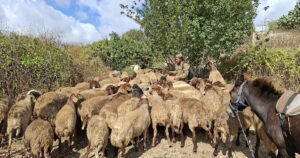
[Shepherd from Kfar Tarfon. Photo: no credit]
Only after the hill was established did the full extent of the destruction at the site become clear. A shepherd who went out with his flock discovered a burial cave that Arabs had looted, with human bones that had been dug up and thrown away in contempt.
The Arab invaders were surprised, but they quickly realized this was a precedent-setting move that was unlikely to be repeated in the near future. They were right. In place of the demolished buildings, the Arabs hurriedly erected two permanent houses from blocks and quickly surrounded them with a concrete wall. At the same time, Arab bulldozers carved out 15 additional construction plots on the other side of the site and hung a sign near the access road inviting local Arabs to buy land at an attractive price. On top of that, the looting of antiquities only intensified.
Two full years passed since that one-time, ineffective enforcement action until a small settlement nucleus composed of veteran activists was established. After more than a decade of activity on the hills of eastern Binyamin, they decided it was time to move on to the next mission and began intensive preparations. They conducted extensive tours, thoroughly reviewed maps, and formulated a suitable settlement plan with our field coordinators in the Front Hills Directorate. The site ultimately chosen for its importance and urgency was the hilltop adjacent to Khirbet Tarfin—a point outside the archaeological polygon but close enough to protect it from further damage attempts. The place was named Kfar Tarfon, preserving the name of the site, which apparently originates from ancient periods. Two families settled there permanently and were joined by a nucleus of young men who took care of the flock.
Only after the hill was established did the full extent of the destruction at the site become clear. A shepherd who went out with the flock of sheep discovered a burial cave that Arabs had looted, with human bones that had been dug up from the ground and thrown away in contempt. The shepherd hurried back to rebury the bones and reported the findings to the archaeology inspectors of the Civil Administration. The sights were shocking, but the consolation was that since the establishment of the hill, additional looters had been prevented from reaching the site and the destruction had been halted.
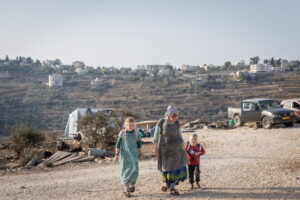
[Settlers of Kfar Tarfon. Photo: no credit]
The two Arab invaders who used to come from time to time to the houses they had placed on the site to supposedly establish their ownership also stopped coming. For the first time in many years, it was possible to say with certainty that the site of Khirbet Tarfin was being preserved in trustworthy hands. Since then, the residents of Kfar Tarfon have also worked with the authorities to close a nearby illegal Arab dump and have consolidated the Jewish presence on both sides of the Binyamin crossing road.
A Prize for Antiquities Terrorism
Throughout this time, the rioters of the Palestinian Authority and the villagers did not rest. After several large-scale violent provocations on the hill itself failed, the rioters switched to attacking the Jewish shepherds. When those attacks also failed and the hill continued to stand firm, the enemy decided to place its hopes on its collaborators inside the State of Israel.
The two Arab invaders who had dared to destroy the remains of the site and carry out construction there in broad daylight filed, with utter insolence, a petition to the High Court of Justice demanding that the state allow them to return to their houses (which they said was currently prevented by “fear of the settlers”) and also order the evacuation of the hill itself.

[Shepherd from Kfar Tarfon. Photo: no credit]
Last week, a day after the High Court hearing, Border Police forces raided the hill and informed the residents that a closed military zone order had been imposed on the site. The next day the forces returned, photographed the residents’ homes, and promised they would return soon.
Let us once again clarify the absurdity so it is clear: Arab invaders who destroyed antiquities, were removed from the site, returned a second time and rebuilt everything from scratch, turned to the state demanding that it secure their criminal activity and grant it official sanction. What was the court supposed to do with the petition? Obviously, reject it out of hand and use their own admission of building the houses to prosecute them for the destruction of heritage treasures. What did the High Court justices do? You guessed correctly. They ordered the state to respond urgently to the claims and also to report within two weeks what actions it had already taken regarding securing the invaders and evacuating the hill.
Unfortunately, the state—meaning the IDF and the Civil Administration—did not go on the offensive and demand that the High Court throw the petitioners out, but instead replied submissively that the hill had already been evacuated several times in the past and that they would soon update the honorable justices on additional actions that would be taken against the settlement point. The state also did not bother to refute the embarrassing claims in the petition regarding acts of violence by the hill’s residents, even though, apart from bombastic headlines, the petitioners attached no documentation of any concrete incident.
Moreover, a white van that was photographed outside the structures and claimed to have transported people who threatened the invaders that they must leave the site was revealed, after a simple check by the hill’s residents, to be a jeep belonging to soldiers of the regional company who had been called to the scene following a security incident.
Last week, a day after the High Court hearing, Border Police forces raided the hill and informed the residents that a closed military zone order had been imposed on the site. The next day the forces returned, photographed the residents’ homes, and promised they would return soon. The following night a convoy of heavy equipment set out to destroy the hill. An alert resident who spotted the forces on their way quickly reported the approaching destruction to the surrounding communities, and dozens of residents went out to the nearby junctions to protest and try to delay the demolition in the hope that someone in the security establishment would come to their senses. Following the widespread protest that delayed the forces, the demolition was postponed for the time being, but Central Command clarified that they are determined to destroy the place soon, come what may.

[Settlers of Kfar Tarfon. Photo: no credit]
As of Tuesday at noon, the time these lines are being written, Kfar Tarfon is still standing. I very much hope that by the time you sit down to read the newspaper, someone in the government will wake up (Katz and Smotrich, you definitely have ways to help on this matter), get into the thick of it, and stop this crime before it is carried out.
In any case, knowing the people of Kfar Tarfon—who are seasoned by hardships and filled with experience and burning faith—they will remain steadfast on this mountain even if they are evacuated a hundred times, long after the High Court is closed and its justices have retired.
[Shepherd from Kfar Tarfon. Photo: no credit]